Similar Shapes: Area
For mathematically similar shapes, corresponding lengths are in the same ratio. If the length scale factor is \(k\), the area scale factor is \(k^2\). To find a length scale factor from areas, take the square root of the area ratio.
Common mistake: Square the length scale factor when scaling areas, not the area itself. Reverse the ratio when going from the larger shape to the smaller shape.
Worked example:
Two shapes, A and B, are mathematically similar. The area of A is 18 cm² and the area of B is 72 cm². Work out the length scale factor from A to B.
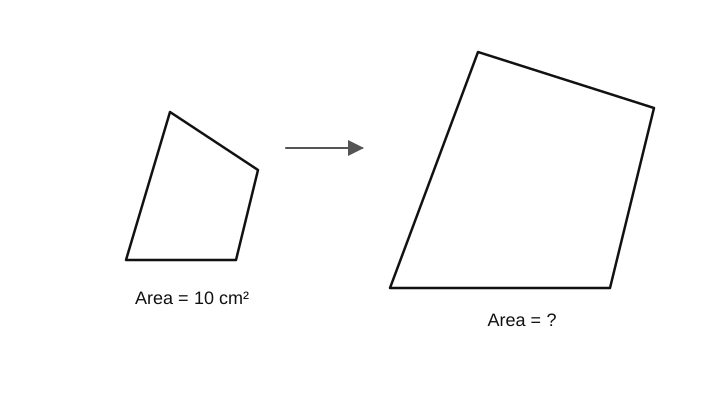
- Step 1Divide the areas to find the area scale factor.\[72 \div 18 = 4\]
- Step 2Take the square root to find the length scale factor.\[\sqrt{4}=2\]
Answer:
The length scale factor from A to B is 2.
Worked example:
Triangle A and triangle B are mathematically similar. The area of A is 10 cm². Work out the area of B. Give your answer in cm².
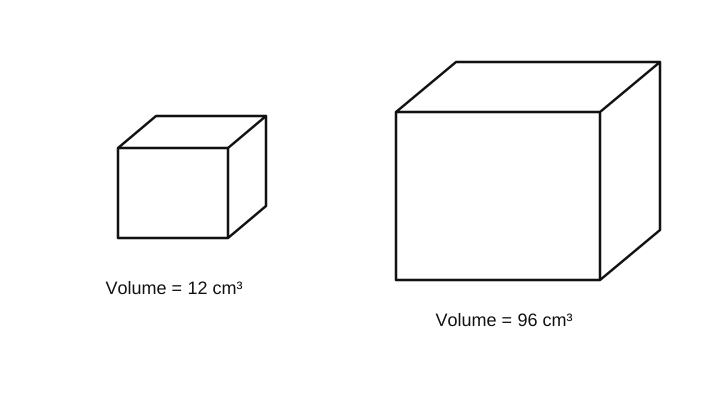
- Step 1Divide corresponding lengths to find the length scale factor.\[8 \div 4=2\]
- Step 2Square this factor and multiply the area of A.\[10\times 2^2=40\]
Answer:
The area of B is \(40\text{ cm}^2\).