Angles in Parallel Lines
When a straight line crosses two parallel lines, some angles are linked by angle facts. Corresponding angles are equal, alternate angles are equal, and co-interior angles add to 180°. First identify the angle relationship, then use the correct fact to find the missing angle.
Common mistake: Do not treat all angles in parallel lines as equal. Co-interior angles add to 180°, so if one is 110°, the other is 70°.
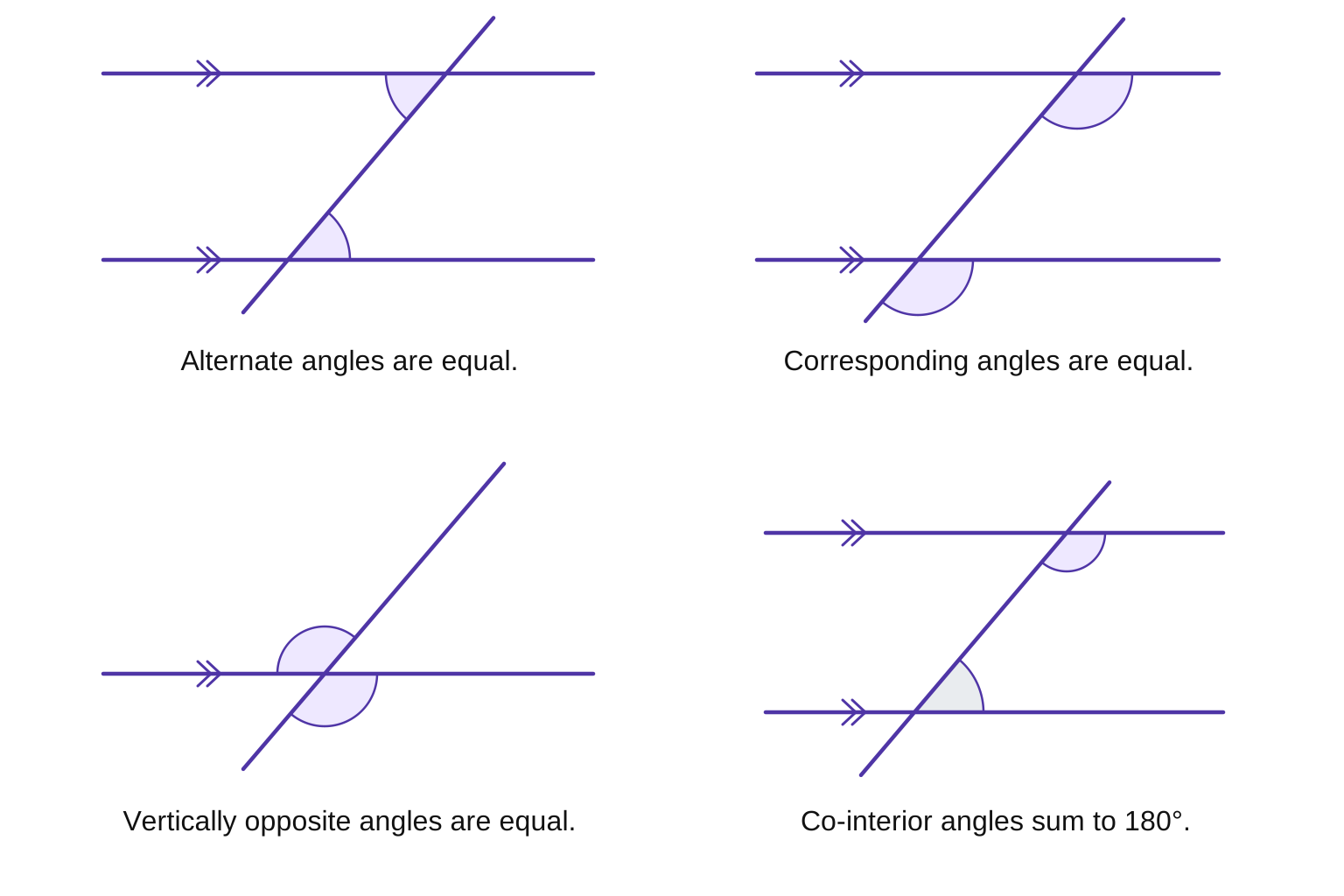
Worked example:
Work out the size of the angle marked \(x\)
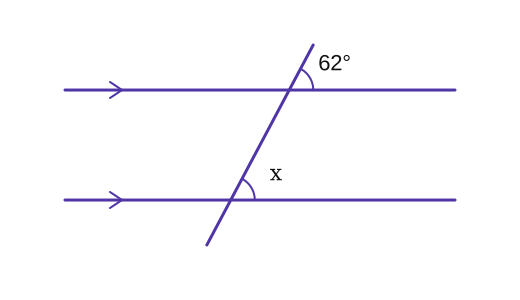
- Step 1The two marked angles are corresponding angles.
- Step 2Corresponding angles on parallel lines are equal.\[x = 62\]
Answer:
\[x = 62^\circ\]
Worked example:
Work out the sizes of the angles marked \(x\) and \(y\), in degrees
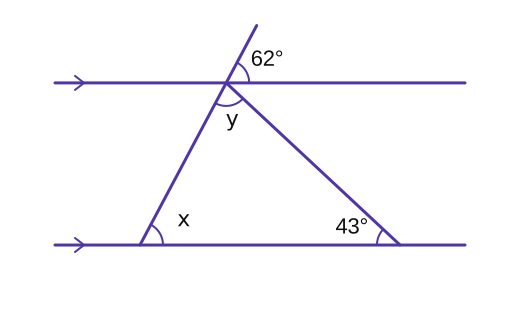
- Step 1First find x using corresponding angles on the parallel lines.\[x = 62^\circ\]
- Step 2Then use the three angles in the triangle, which add to 180°.\[y = 180 - 62 - 43 = 75^\circ\]
Answer:
\[x = 62^\circ,\quad y = 75^\circ\]