How to revise effectively according to the research
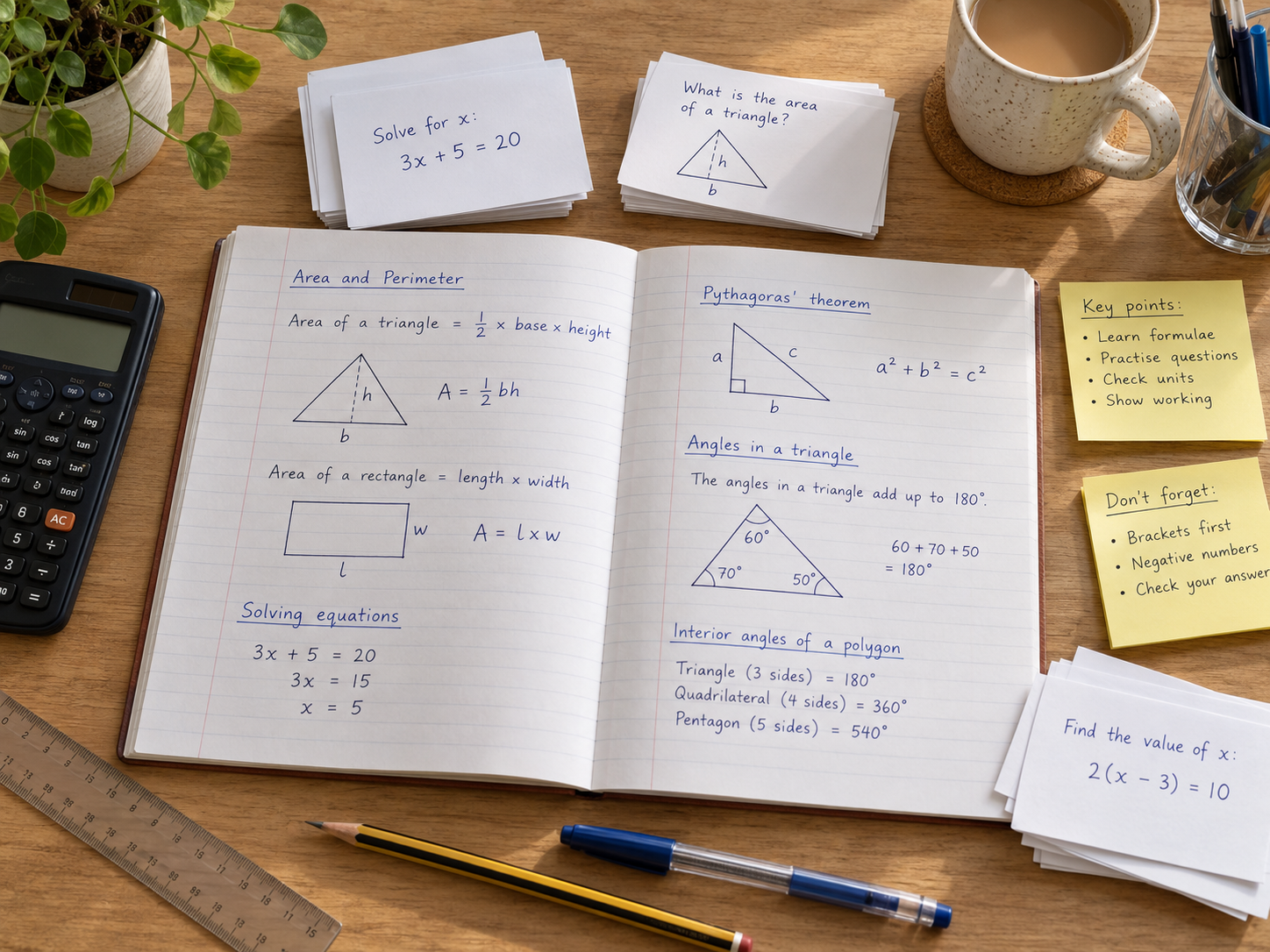
Making revision time count
You can spend an evening reading your maths notes and feel that everything makes sense. Then a question appears without a worked example beside it, and suddenly you are not sure where to start. That gap can be frustrating, especially when you have put the time in.
Research offers some helpful guidance. Practising recall, revisiting material over time and mixing suitable question types can make revision more useful. These approaches are called retrieval practice, spacing and interleaving. You can build all three into an ordinary week of GCSE maths revision.
A major review of learning techniques rated practice testing and distributed practice highly, while finding more conditional evidence for interleaving. Re-reading and highlighting received lower ratings as general study strategies. That does not make notes useless: what matters is what you do after reading them.
Retrieval practice: try it before looking
Retrieval practice means bringing something to mind without having the answer in front of you. In maths, that could mean recalling an angle fact, explaining the steps in a method, or solving a question with your notes closed. A low-stakes quiz counts too; it does not have to feel like a formal exam.
In one experiment, researchers compared repeated study with recall practice using written passages. Students who practised retrieval remembered more on delayed tests, even though repeated reading could feel more reassuring. This was a memory experiment, rather than a GCSE maths trial, but it illustrates why recognising a solution is different from producing one yourself.
Try this with substitution. Read a worked example, cover it, then attempt a fresh question on paper. Before checking, explain what you substituted and why. You are practising both remembering the method and carrying it out.
Next, check your answer and working against a reliable solution. If you made a mistake, find the step that went wrong, revisit the explanation and try another question. Returning to it later gives you a better check than immediately copying the correction. If you cannot start at all, use a hint or worked example and ask for help where needed. Retrieval practice should include support, not endless guessing.
Spacing: give topics another appointment
Spacing means spreading practice on the same material across separate occasions. Instead of doing all your percentage revision on Sunday, you might practise on Sunday, return on Wednesday and revisit it the following week. The important part is coming back to the topic.
A large review of memory research found that distributing study improved retention across many verbal-memory experiments. The most useful gap depended partly on how long learners needed to remember the material. There is no single timetable that is best for every topic or student.
For GCSE maths, a practical starting point is to revisit a topic after a few days, then again the following week. That is a suggested routine, not a scientifically fixed interval. Bring the next review closer if you are struggling; leave a longer gap once you can solve fresh questions confidently.
Start each return visit by attempting something from memory. If you have forgotten a step, use that as information about what needs attention. You do not need to forget everything for spacing to be worthwhile, and a revision session does not have to feel difficult throughout to be useful.
Interleaving: practise choosing the method
Interleaving means mixing different types of problem within practice. Once you have learnt the individual methods, you might work on a percentage question, an equation and an angle problem in the same session. Before calculating, ask: what kind of problem is this, and which method fits?
That choice matters in a maths exam. When a worksheet contains twenty nearly identical questions, the method is often obvious before you read the next one. A suitable mixture gives you practice deciding how to begin as well as completing the calculation.
In a classroom study, researchers gave pupils the same maths problems in different arrangements. More interleaved practice led to better performance on later tests with new problems. The pupils were in US seventh grade, so the result supports trying mixed maths practice; it does not promise a particular improvement in your GCSE grade.
Build some understanding of a new method before mixing it with others. If you have just met simultaneous equations, a worked example and several focused questions may be the right place to start. Add a small mixture of familiar question types as you become more secure. Interleaving does not mean switching topics every minute or attempting lots of methods you have never learnt.
Spacing and interleaving answer different questions. Spacing is about when you return to material; interleaving is about which problem types you mix. You can revisit equations on separate days without mixing them with other topics, or mix several topics in one session and still need to return to them later.
Where do reading and highlighting fit?
Reading an explanation is useful when you are learning or repairing a gap. Highlighting a key condition can help you notice it. The problem is relying on those activities as your only evidence that you can answer a question independently.
After reading, close the explanation and do something with it. State the rule in your own words, explain a step aloud, or attempt a fresh question. Check what you produced. If it is incomplete, return to the explanation with a specific question in mind. Your notes then support practice instead of becoming the whole session.
How GCSE Maths Lab can help
GCSE Maths Lab gives you a practical way to put these ideas into action. Use a topic recap to refresh a method, then attempt the quiz without looking back to practise retrieval. Return to that topic on another day to space your practice, and use Mixed Practice to combine familiar topics and practise choosing the right method. To start your journey, click here.